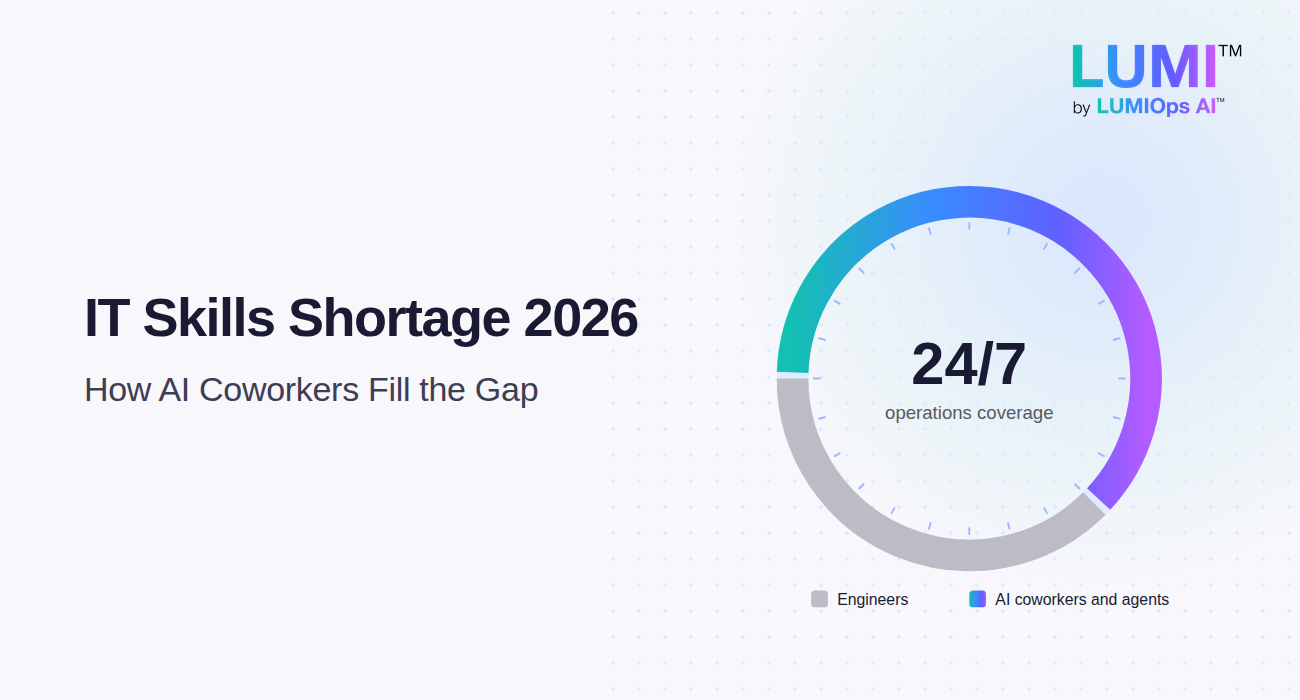
IT Skills Shortage 2026: How AI Coworkers Fill the Gap

The IT skills shortage is no longer a forecast. It is an operating condition. IDC predicts that by 2026, more than 90% of organizations worldwide will feel the pain of the IT skills crisis, amounting to some $5.5 trillion in losses caused by product delays, impaired competitiveness, and loss of business.
IT operations sit at the centre of that pressure. AI skills are currently the most in-demand, but IT operations skills are also highly sought after. The engineers who keep production running are among the hardest people to hire and the most expensive to lose.
This article examines why hiring alone cannot close the operations skills gap. It then shows how AI coworkers and specialized agents change the capacity equation for enterprise IT.

The Scale and Cost of the Skills Shortage

The impact extends well beyond open requisitions. In IDC’s survey of North American IT leaders, nearly two thirds said a lack of skills had resulted in missed revenue growth objectives, quality problems and a decline in customer satisfaction.
Transformation timelines suffer as well. Skills gaps in IT operations, cloud architecture, data management and software development triggered digital transformation delays of up to 10 months for nearly two-thirds of organizations.
Operations leaders report the same pattern. According to Omdia’s February 2026 research on AI in IT operations:
  • 22% of organizations cite skill shortages and difficulty hiring qualified IT staff as drivers for AI adoption.
  • An equal share cites the need for around-the-clock AI agents to augment limited staff.

Why Hiring Alone Cannot Close the Gap in IT Operations

Recruitment remains necessary, but IT operations has structural characteristics that hiring cannot resolve on its own.
Coverage is continuous; headcount is not. Production systems run 24 hours a day. Experienced SRE and platform engineers remain in high demand, and many organizations struggle to staff 24/7 on-call rotas. Every overnight shift draws on the same limited pool of senior engineers.
Specialist depth is spread across too many domains. A single incident can involve routing, storage latency, database locks, and recent deployment. Few teams have a specialist available in every domain at every hour.
Knowledge leaves with people. Operational expertise accumulates over the years and is rarely documented in full. When an experienced engineer leaves, the organization loses that knowledge as well as the capacity.
Hiring cycles lag demand. Sourcing, interviewing, and onboarding a qualified engineer takes months. Incident volume does not wait for the hiring cycle to complete.

Two Ways AI Adds Operations Capacity

AI closes the operations skills gap in two distinct ways. Each addresses a different constraint.
AI coworkers extend the individual engineer. An AI coworker works alongside a named engineer across all IT operations. Unlike a chatbot that answers questions, it investigates, gathers evidence and executes work within defined permissions. It has four defining attributes:
  • Identity binding. Each coworker is assigned to a specific engineer and works within that engineer’s inbox, ticket queue and permissions, rather than acting as a shared bot.
  • Breadth across IT operations. A single coworker supports the full range of an engineer’s daily work, from ticket handling to investigation and routine changes.
  • Continuous availability. Coworkers operate around the clock, including overnight shifts, weekends, and holiday periods.
  • Immediate provisioning. New coworkers can be added in minutes, without a recruitment process or onboarding delay.
Specialized agents extend the team’s domain depth. An orchestration layer coordinates agents that each carry encoded expertise for one domain. When an incident spans several layers of the stack, the orchestrator brings the relevant specialists together. It correlates their findings into a single incident and drives it through to resolution.

Where Specialized Agents Close Domain Skills Gaps

Skills GapSpecialized Agent RoleOperational Effect
Network specialistsDiagnoses routing, BGP, VLAN and firewall faultsFaster network troubleshooting without waiting for scarce experts
Compute and virtualizationMonitors CPU, memory, disk I/O and hypervisor behaviorProactive capacity management and fewer resource-related incidents
Storage engineeringTracks IOPS, latency, throughput and capacity trendsEarlier detection of storage constraints before they cause outages
Database administrationAnalyses query plans, lock contention and replication lagFaster database incident resolution and reduced data risk
Security operationsApplies threat detection, anomaly analysis and compliance rulesFaster containment and continuous compliance checks
Cloud operationsManages IAM policies, service quotas and multi-cloud configurationFewer misconfigurations and consistent governance across providers
AI also changes how quickly new engineers contribute. Omdia reports that 49% of organizations agree AI allows lower-skilled or junior workers to be more productive sooner. Correlated evidence and specialist context for every investigation shorten the path from new hire to fully productive engineer.

A Workforce Model for Human and AI Operations

The objective is not to replace engineers. It is to allocate work according to where each contributes most.
AI coworkers and specialized agents take on:
  • alert triage and event correlation
  • first-pass investigation and evidence gathering
  • execution of repeatable, well-defined remediation
  • overnight and weekend coverage
Engineers retain:
  • architecture and design decisions
  • approval of high-impact changes
  • judgment on novel or ambiguous incidents
  • continuous improvement of runbooks and standards
This division holds only when governance is explicit. Approval policies, scope limits, and a complete audit trail ensure that AI extends engineering capacity without extending operational risk.

How to Introduce AI Coworkers and Specialized Agents

1. Map coverage gaps. Identify the domains, shifts, and incident classes where specialist availability is weakest.
2. Start with the highest-toil area. Deploy first where repetitive work consumes the most engineering hours.
3. Bind coworkers to named engineers. Assign each coworker to an owner who reviews its work and remains accountable for outcomes.
4. Begin in read-only mode. Let AI investigate and propose actions before granting execution rights.
5. Measure against a baseline. Track four measures:
  • escalation rate
  • overnight response time
  • mean time to resolution
  • engineering hours spent on routine work

How LUMIOps AI Addresses the Operations Skills Gap

LUMIOps AI addresses the skills gap through its product suite, comprising:
SRE Orchestrator is a master agent built for end-to-end incident intelligence. It coordinates specialized agents for network, compute, storage, database, security, and cloud operations. It correlates signals across every domain into a single incident and drives that incident from detection to resolution.
ITOps Coworker works alongside engineers across all IT operations. It operates within each engineer’s own queue, identity, and permissions. It takes on investigation, routine execution and coverage outside core hours.
The LUMIOps AI portfolio also includes FinOps Orchestrator and Security Orchestrator.
Every action runs within approval gates, scope limits, and an immutable audit trail. In incident resolution, LUMIOps AI:
  • resolves 85% of L1 and L2 incidents autonomously
  • automates 90% of routine tasks
  • reduces operational overhead by 40 to 60%
See How LUMIOps AI Augments Your IT Operations Team
Autonomous ITOps platform powered by an AI Coworker, SRE Orchestrator, and Agent Builder
© 2026 – 2027 LumiOps.AI. All rights reserved.

© 2026 – 2027 LumiOps.AI. All rights reserved.