Conversational ITOps: Manage IT Operations with Natural Language

Every incident, request, and change begins with a question. Why is latency rising? What changed in the last hour? Which services depend on this database? Teams that manage ITOps with natural language ask those questions directly. They receive answers built from live operational data, with every finding linked to its evidence.
But is natural language management really required for IT Operations management? Yes, three conditions make natural language a practical requirement for enterprise IT operations are:
  • Estates are growing more complex. Hybrid infrastructure, multiple clouds, and interdependent services generate more signals than any team can review manually. According to Omdia’s February 2026 research on AI in IT operations, 47% of organizations cite the increasing complexity of IT infrastructure as the top driver for AI adoption in operations.
  • Operational knowledge must be accessible to the whole team. When answers depend on a few senior engineers, their availability limits the pace of every investigation and task. Natural language extends that access to every engineer on the team.
  • Speed matters most under pressure. During an active incident, the time between a question and a reliable answer directly shapes resolution time.

How to Manage ITOps with Natural Language

Conversational ITOps allows engineers to ask operational questions and direct operational work in plain language. Answers and actions are built from live operational data. The process works in three stages:
  • Intent: The system interprets the request and determines its scope: which services, which time window, which signals.
  • Retrieval: It gathers the relevant data across metrics, logs, traces, deployments, tickets, inventory, and runbooks.
  • Correlation: It returns a single, evidence-backed answer or recommended action rather than a set of disconnected results.
This is distinct from a general-purpose chatbot. A general-purpose chatbot answers from what it already knows. A natural language ITOps interface answers from the organization’s own telemetry, estate data and operational history.

How a Natural Language Query Resolves

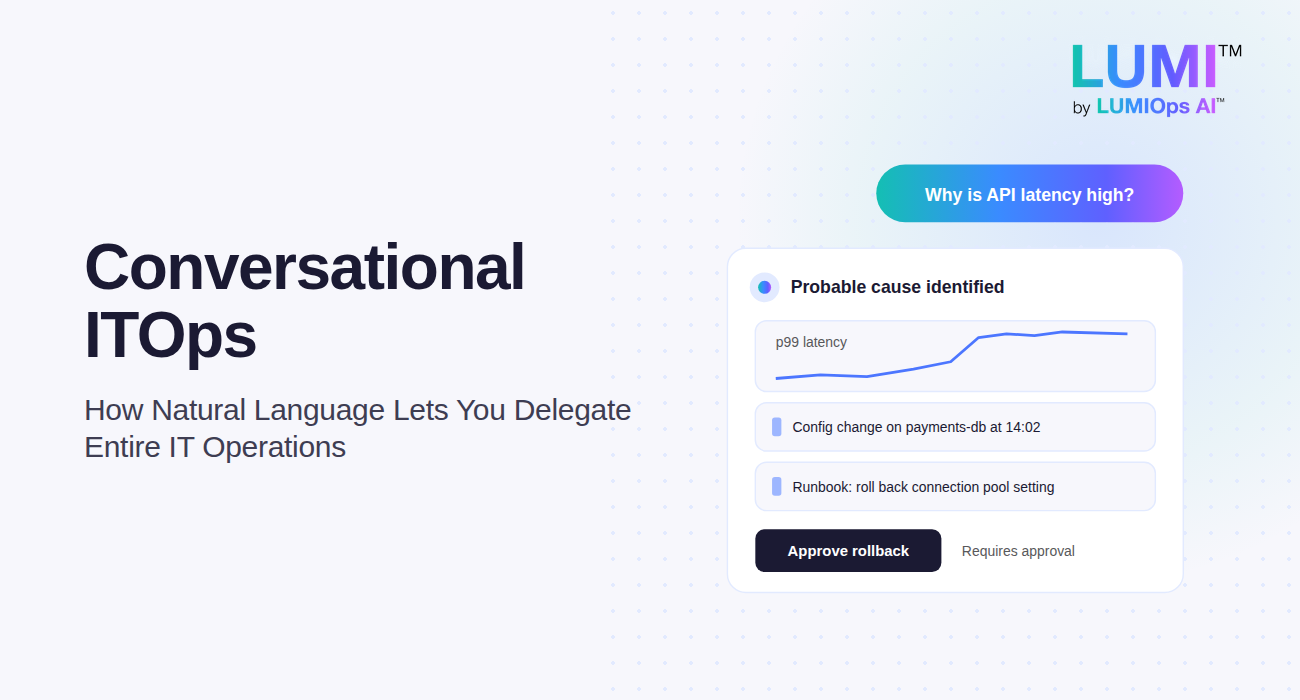
Consider the question: “Why is API latency high?”
  • Scope identification: The system identifies the affected API, its dependencies, and the time window in which latency deviated from baseline.
  • Signal retrieval: It gathers latency and error metrics, relevant logs and traces, recent deployments and configuration changes.
  • Context assembly: It adds related incidents, open tickets and applicable runbook guidance.
  • Correlated answer: It returns the most probable cause, the supporting evidence for each finding and a recommended next action.
The engineer receives a complete, evidenced answer in seconds.
Natural language also shortens the path to productivity for new team members. Omdia reports that 49% of organizations agree AI allows lower-skilled or junior workers to be more productive sooner.

Requirements for Trustworthy Natural Language Answers

An answer is only useful if it can be trusted. Enterprise natural language interfaces should meet six requirements:
  • Evidence for every conclusion: Each finding links to the metrics, logs, traces, or change record that supports it.
  • Grounding in the organization’s estate: Answers draw on live telemetry, tickets and runbooks, not generic model knowledge.
  • Access control at retrieval: Users see only the data their role permits, enforced when the answer is generated.
  • Private model options: Organizations can run the language model privately and keep operational data within approved regions.
  • Gated actions: Recommended actions are executed only after approval under a defined policy.
  • Full auditability: Every question, answer and resulting action is logged.
Explainability is becoming a baseline expectation across AI deployments. Gartner predicts that by 2028, explainable AI will drive LLM observability investments to 50% of GenAI deployments, up from 15%.

How LUMIOps AI Delivers Conversational ITOps

LUMIOps AI is built for teams that want to delegate IT operations to an AI team, not just incident resolution. Conversational ITOps is the interface to that delegation. Engineers use plain language to direct, build, and govern work across the entire operational estate.
Operate Across the Estate
  • Workspace and Inbox: Alerts, incidents, tickets and estate inventory in one console, with work routed to the right engineer or agent.
  • Service desk: Triage, route and resolve tickets, and draft responses for review.
  • Estate, Sites and IPAM: Query inventory, dependencies and IP allocation across hybrid and multicloud environments.
  • Telemetry and AIOps: Stream live signals, learn baselines, detect anomalies, and correlate events into actionable incidents.
  • Governed terminal operations: Execute commands on hosts with role-based access and session logging.
  • Incident intelligence: Investigate, diagnose and remediate with SRE Orchestrator’s specialized agents.
Build and Extend Automation
  • Agent Builder and Agent Team: Start from curated agents, then fork and tune their roles, skills, guardrails and knowledge sources. Test each agent in discovery mode before promoting it to production.
  • Skills: Encode standard operating procedures as structured skills with defined inputs, steps, constraints, and outputs. Version and promote each skill across development, test and production.
  • Workflows: Design automations visually with triggers, conditions, approvals, scripts, Terraform and API calls.
  • Knowledge and Retrieval: Ingest runbooks and documentation, so every answer cites its source. Access is enforced at private, team or organization scope.
Govern and Observe
  • Runs: Replay every execution step by step, with inputs, outputs, tool calls and failure points.
  • Agent Observability: Monitor agent performance, accuracy, and actions over time.
  • Guardrails: Apply approval gating, blast-radius caps, a global kill switch, model policy and regional processing controls.
Optimize Cost, Security & Sustainability
Connect
  • Integrations and Connectivity: Connect to observability, ITSM, on-call, code, infrastructure-as-code and collaboration tools. Coverage spans Azure, AWS, GCP, OCI and on-premises datacenters.
Every answer and action draws on a unified model of the organization’s estate: telemetry, tickets, runbooks and recent changes. Recommendations include an execution option with pre-filled parameters, subject to approval gates.
The platform supports private LLMs and enforces SSO, role-based access control, and a full audit trail. It can automate 90% of your routine tasks. In incident resolution, it resolves 85% of L1 and L2 incidents autonomously and reduces operational overhead by 40 to 60%.
Delegate IT Operations to LUMI
Autonomous ITOps platform powered by an AI Coworker, SRE Orchestrator, and Agent Builder
© 2026 – 2027 LumiOps.AI. All rights reserved.

© 2026 – 2027 LumiOps.AI. All rights reserved.