AI SRE Tools 2026: The Complete Buyer's Guide

Site reliability engineering has reached a scaling limit. Service estates now span hybrid infrastructure, multiple clouds and hundreds of interdependent services. The teams responsible for keeping them available have not grown at the same rate.
The market has noticed. By 2029, 85% of enterprises will use AI SRE tooling to optimize operations and meet organizational and customer reliability demands, up from less than 5% in 2025. The distance between those two figures is where this year’s buying decisions will be made.
This guide covers four things: what AI SRE tools do, which capabilities matter, how to assess governance, and how to adopt the category without introducing new operational risk.

What AI SRE Tooling Is and Why the Category Formed

Gartner published its first Market Guide for AI Site Reliability Engineering Tooling in January 2026, formally recognizing it as a distinct category. The category sits between observability and automation. Vendors in this area analyse telemetry and event data, identify likely root causes, and recommend or execute remediation steps.
The distinction from traditional monitoring matters:
  • Observability platforms report what happened.
  • Legacy AIOps groups the resulting alerts.
  • AI SRE tools investigate the incident, explain the cause and act on it, within limits the organization defines.
Buyers should also know where the market stands today. Many of the representative vendors are startups; most solutions target reactive operations rather than proactive prevention, and pricing models are still in flux. Rigorous evaluation criteria therefore carry more weight than category labels.

The Operational Pressures Behind Adoption

Three pressures explain the forecast.
Infrastructure complexity. According to Omdia’s February 2026 research on AI in IT operations, 47% of organizations cite the increasing complexity of IT infrastructure as the top driver for AI adoption in operations.
Capacity constraints. Gartner states that traditional SRE and operations teams “cannot keep up with the technology and operational demands required of them.” Experienced SRE and platform engineers remain in high demand, and many organizations struggle to staff 24/7 on-call rotas. Omdia finds that 22% of organizations cite skill shortages as direct drivers.
Demand for self-healing. In the same Omdia study, 29% of organizations name the need for autonomous remediation or self-healing as a top driver. Detection alone is no longer the objective. Resolution is.

Core Capabilities to Evaluate

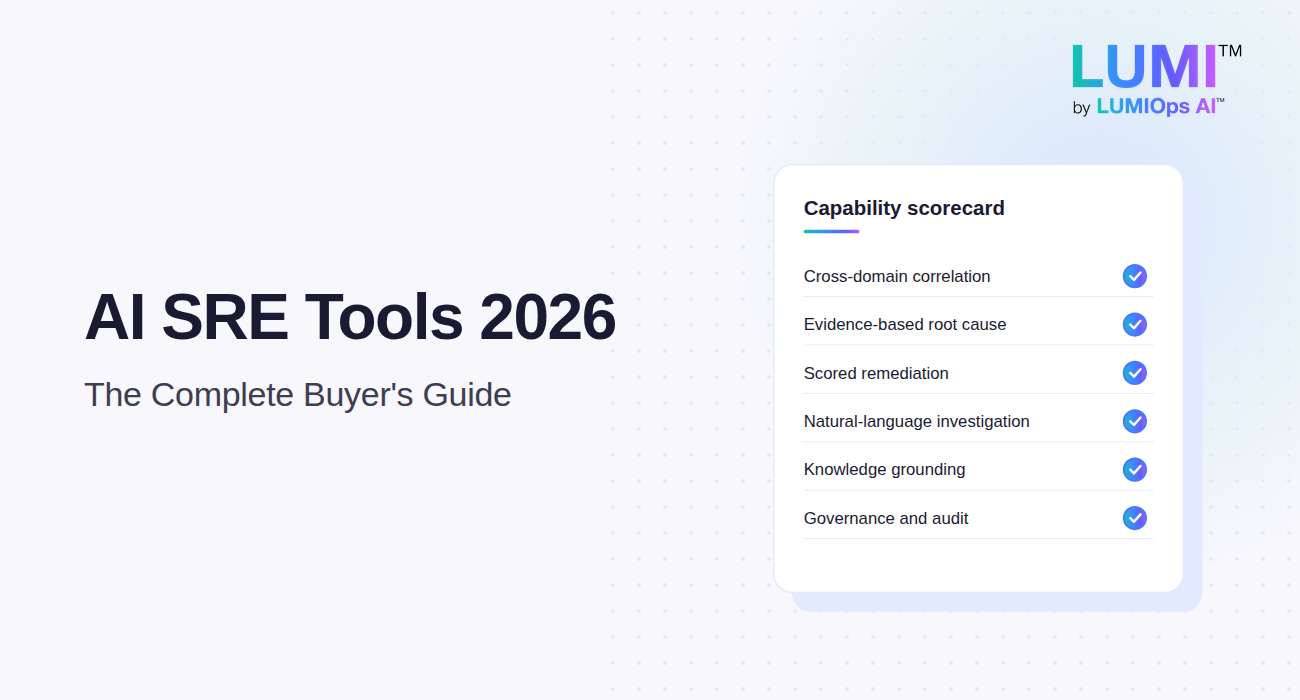
A credible AI SRE tool should demonstrate the following six capabilities in a live environment, not a scripted demo.
  • Cross-domain event correlation. The tool should consolidate signals from network, compute, storage, database, and application layers into a single incident. Tools that correlate within one domain only will reproduce the silos they claim to remove.
  • Evidence-based root cause analysis. Every conclusion should link to supporting evidence: the metric deviation, the log pattern, the recent deployment or configuration change. Conclusions without evidence cannot be audited or trusted.
  • Remediation proposals with confidence scores. Recommendations should be specific and executable, and each should carry a stated confidence level and a rollback plan.
  • Natural language investigation. Engineers should be able to ask operational questions in plain language without writing PromQL, SQL or KQL. This widens access to operational data beyond senior specialists.
  • Knowledge grounding. The tool should retrieve and cite the organization’s own runbooks, SOPs and ticket history. Generic model knowledge is not a substitute for institutional context.
  • Integration depth. Native connectors for observability, ITSM, on-call, infrastructure-as-code, Kubernetes and cloud provider APIs determine whether the tool works within existing workflows or adds another console to monitor.

Governance Criteria That Determine Production Readiness

Capability determines what a tool can do. Governance determines whether it can be trusted to do it in production.
The risk is documented. By 2029, 90% of organizations will experience an AI-caused outage such as erroneous recommendations yet continue AI SRE for its speed and scalability gains. Omdia’s data points the same way: 17% of organizations cite the need for new human-in-the-loop approval processes as a barrier to adoption.
The following controls separate production-ready tools from experimental ones.
ControlWhat to Verify
Approval gatingPolicy-based rules that auto-approve low-risk actions and require human sign-off for high-impact changes
Blast-radius capsHard limits on the number of hosts, services or regions any autonomous action can affect
Kill switchA global autonomy toggle plus per-agent disablement, effective immediately
Dry-run modeAgents investigate and propose without executing until explicitly promoted
Immutable audit trailEvery action logged with actor identity (human or AI), inputs, outputs, timestamps and rollback status
Model and data controlsChoice of model tier, support for private or hosted models, and regional restrictions on AI processing

Vendor Evaluation Questions

Use these questions to structure shortlisting conversations and proof-of-concept scoring.
QuestionWhat a Strong Answer Includes
How does the tool reach a root cause conclusion?Traceable evidence chain with links to telemetry, changes and tickets
What can the tool execute without human approval?Configurable policy, defined per action type and environment
How is the scope of an autonomous action limited?Enforced caps on hosts, services and regions, not advisory settings
How quickly can autonomy be halted?Immediate global and per-agent stop, with no pending actions completing
Where is operational data processed?Stated regions, customer-controlled residency and private model options
How is accuracy measured over time?Reusable runs, failure analysis and comparison against human baselines

A Phased Adoption Roadmap

Adopting AI SRE tooling is a trust-building exercise. A three-phase approach contains risk while value accumulates.
Phase 1: Discovery. Deploy agents in read-only mode. They investigate incidents and propose actions but execute nothing. Compare their root cause conclusions against those of human engineers to establish a baseline for accuracy.
Phase 2: Gated execution. Enable execution for low-risk, repeatable actions under approval policies. High-impact changes continue to require human sign-off. Review the audit trail weekly.
Phase 3: Guardrailed autonomy. Grant scoped autonomy for incident classes with a proven record, bounded by blast-radius caps and kill-switch controls. Expand scope only when the metrics support it.
Track four metrics across all three phases:
  • mean time to resolution
  • the ratio of raw alerts to actionable incidents
  • the share of incidents resolved without escalation
  • engineering hours spent on toil

How LUMIOps AI Approaches AI SRE

LUMIOps AI pairs a SRE Orchestrator with specialist agents for network, compute, storage, database, security and cloud operations. The Orchestrator evaluates system state on a deterministic cycle: condition, proposal, approval, execution. Each step is visible in real time, so operators always know what the system is doing and why.
Governance is built into the core. It includes:
  • approval gating
  • blast-radius caps
  • a global kill switch
  • dry-run promotion
  • an immutable audit trail
  • support for private models
  • regional processing controls
In incident resolution, LUMIOps AI resolves 85% of L1 and L2 incidents autonomously, automates 90% of routine tasks and reduces operational overhead by 40 to 60%.

Experience Governed Autonomy in Your Own Environment

Autonomous ITOps platform powered by an AI Coworker, SRE Orchestrator, and Agent Builder
© 2026 – 2027 LumiOps.AI. All rights reserved.

© 2026 – 2027 LumiOps.AI. All rights reserved.