What if scaling IT operations did not always require scaling the team responsible for them?
LumiOps AI enables IT teams to delegate operational tasks – from infrastructure management and ticket handling to incident investigation and remediation – to AI Coworkers operating within enterprise-defined guardrails.
The goal is simple: enable teams to execute more, accelerate operational velocity, and reduce manual effort.
As IT environments grow in size and complexity, meeting rising operational demands should not depend on continually expanding headcount. It should depend on augmenting the execution capacity of existing teams. However, achieving this requires more than deploying AI agents. It requires connecting operational context, tools, specialized expertise, and execution controls so that delegated work can move from investigation to action.
Let’s look at how LumiOps AI brings these elements together to enable Autonomous IT Operations.
Reliable delegation requires more than capable AI agents. It requires an understanding of the environment, access to relevant tools, coordinated execution, and clearly defined guardrails.
LumiOps AI brings these elements together through a connected operational workspace, a unified estate model, specialized AI Coworkers, and a framework for building and governing automated workflows.
Connect your existing environment through collectors and APIs. LumiOps AI brings operational work into a shared workspace through Inbox, Investigations, AIOps, Service Desk, Terminal, and Web Console.
Engineers can ask questions in natural language, investigate issues, review tickets, and access infrastructure. Telemetry and ticket data help inform investigations, while next-best-action recommendations connect findings to available execution options.
This brings investigation and action into the same workflow, reducing the need to switch between disconnected tools.
LumiOps AI provides dedicated operational views through Ops Console, Estate, IPAM, Telemetry, and Sites. Its unified estate model connects discovered infrastructure with metrics, dependencies, source lineage, and applicable automations.
This context helps agents look beyond an isolated alert. They can identify the affected resource, examine its relationships and current condition, and determine which actions are available.
The result is a clearer understanding of what is happening, what is affected, and what can be done about it—providing the context needed to make informed operational decisions.
LumiOps AI provides specialized ITOps Coworkers for network faults, compute performance, storage constraints, database issues, and cloud operations.
The SRE Orchestrator coordinates these specialists across incident investigation and remediation, with human approval requirements governing actions where needed.
Instead of handling every task independently, teams can coordinate specialized capabilities within a single operational process. This allows work to progress across multiple stages while keeping execution within defined permissions and approval requirements.
Agent Builder lets teams define agent roles, assign skills, connect knowledge and tools, and establish execution boundaries.
Workflows combine triggers, conditions, approvals, scripts, Terraform, and API calls to automate operational procedures. Skills turn standard operating procedures (SOPs) into structured, reusable instructions that agents can apply across recurring tasks.
Knowledge connects agents to organizational documentation. Runs provides execution traces and replay, while Agent Team and Agent Perf provide dedicated views for managing agents and reviewing their performance.
Together, these capabilities allow teams to customize automation around their operational requirements and make established expertise reusable across workflows.
Autonomy does not mean unrestricted access. An agent investigating an issue should not necessarily have the same authority as one making changes in production.
LumiOps AI uses permissions, approval gates, and blast-radius limits to define delegated authority. Operators can tune or stop autonomous execution as conditions change, keeping human involvement aligned with the scope and risk of the work.
The platform connects with existing tools, including Datadog, Grafana, Prometheus, Splunk, ServiceNow, Jira, PagerDuty, Kubernetes, GitHub, AWS, Azure, and GCP. Enterprises can introduce autonomous workflows without replacing the systems they already rely on.
Private or hosted model options and private, team, or organization-level knowledge retrieval support different enterprise requirements. Execution traces, proposals, approvals, and handoffs make delegated work reviewable.
Together, these controls establish how autonomy works in practice: context informs decisions, permissions define authority, and approval policies determine when execution can proceed.
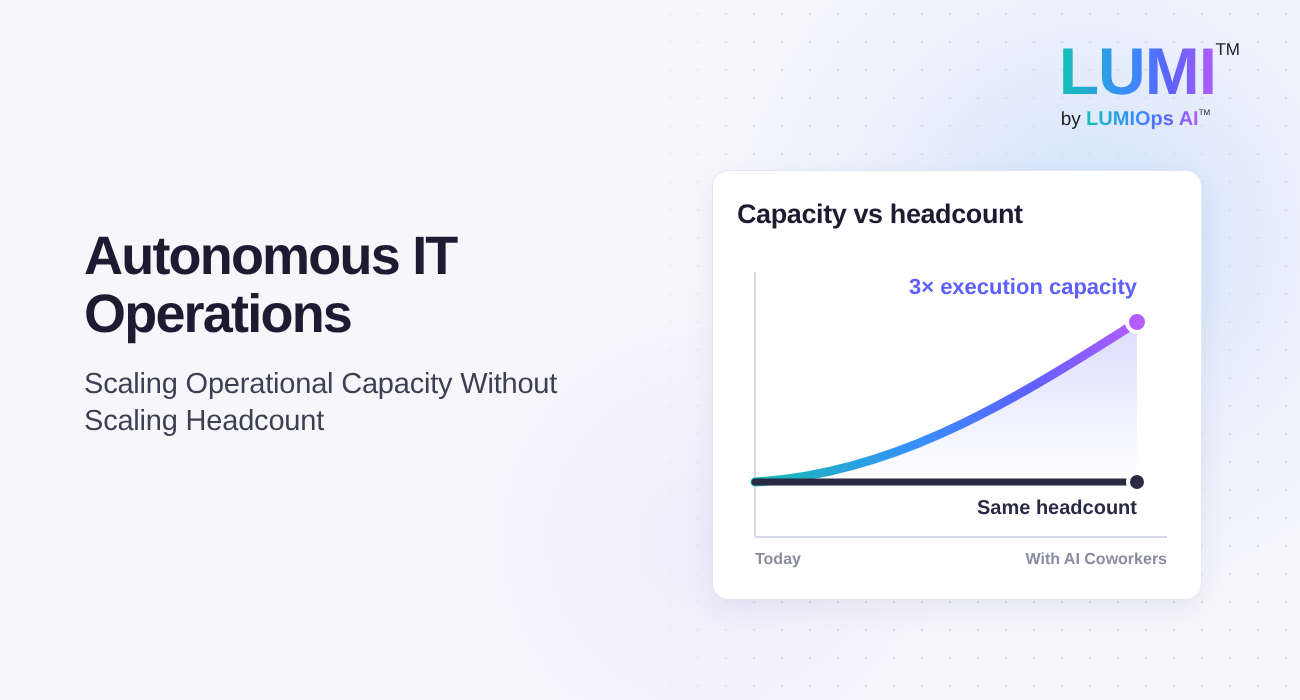
LumiOps AI targets 3× engineering productivity by enabling teams to delegate routine operational work, coordinate incident response, and reuse established expertise through AI-driven execution.
Autonomous ITOps changes how operational work gets done. Engineers define the objectives, context, and guardrails, and decide where human approval is required. AI Coworkers take on the delegated work, apply specialized skills, and coordinate execution within those boundaries. As more tasks become repeatable and delegable, teams scale what they accomplish, not the size of the team.
Start with the workflows that consume the most engineering time. Connect your existing tools, configure AI Coworkers for that work, and define the authority they need to execute safely. Then expand delegation as your requirements evolve.
Book a demo to see how LumiOps AI expands your team’s operational capacity. contact us
Experience Governed Autonomy in Your Own Environment

Chat instead of ten dashboards — your coworker does the work.
One engine coordinating reliability, security, and cost.