Agentic ITOps: 7 Use Cases That Cut MTTR by 40%

Mean time to resolution is rarely lost in the fix. It is lost in the minutes and hours before it: sorting alerts, assembling context, finding the right specialist, and confirming the cause. Agentic AI targets exactly that interval.
The demand is clear. According to February 2026 research on AI in IT operations by Omdia, 29% of organizations cite the need for autonomous IT remediation or self-healing as a top driver for AI adoption.
The risk of poor execution is equally clear. Gartner predicts that over 40% of agentic AI projects will be canceled by the end of 2027, due to escalating costs, unclear business value, or inadequate risk controls. The difference between the two outcomes is use case selection.
This article sets out seven use cases where agentic AI delivers measurable MTTR reduction in IT operations.
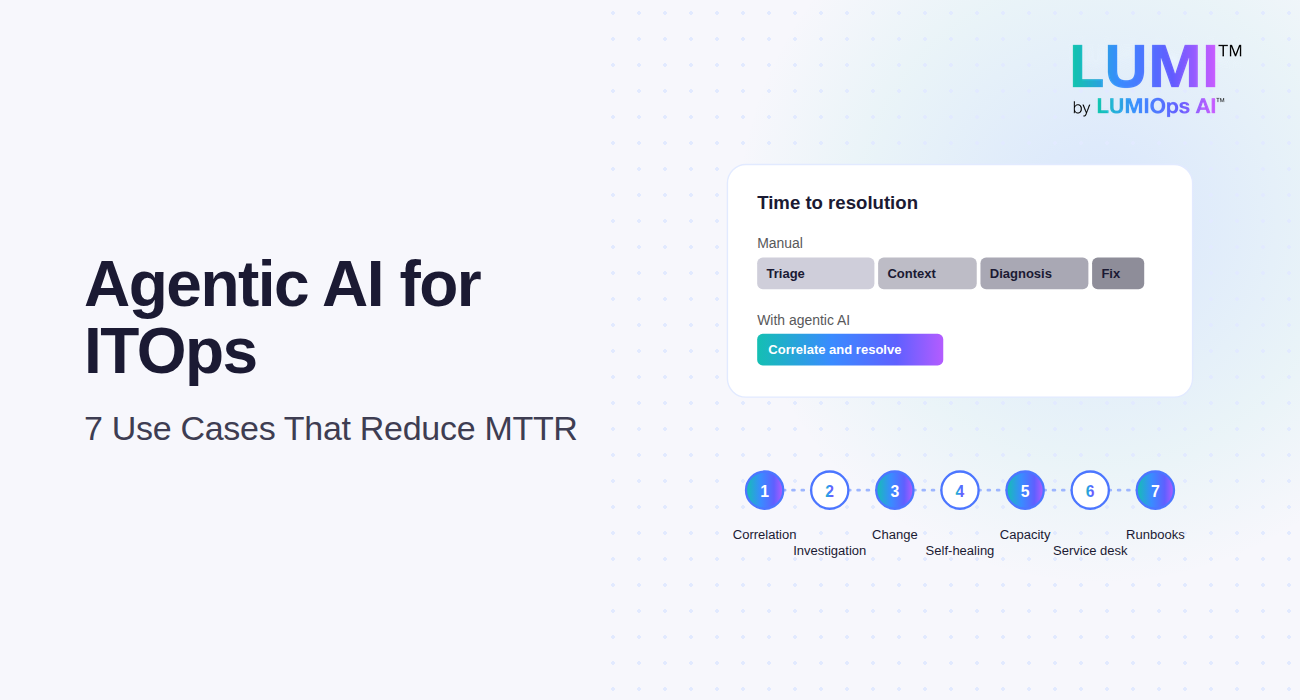

What Makes AI Agentic in IT Operations

Traditional automation executes predefined scripts. Agentic AI pursues an operational goal. It observes system state, reasons for cause, selects an action and verifies the result.
The label is widely misused. Gartner warns that many vendors are “agent washing”, rebranding assistants, RPA tools and chatbots without substantial agentic capabilities. It estimates that only about 130 of the thousands of agentic AI vendors are real.
In IT operations, a genuinely agentic system must do four things:
  • correlate signals across domains
  • investigate autonomously
  • execute remediation within defined policy
  • confirm that the service has recovered

Use Case 1: Alert Correlation and Noise Reduction

A single fault can generate dozens of alerts across monitoring tools. Engineers spend the opening minutes of every incident deciding which alerts matter. Agents group related events across network, compute, storage, database and application layers into a single actionable incident. Duplicates and downstream symptoms are suppressed. Triage time falls because engineers begin with one incident and a clear scope, not an alert queue.

Use Case 2: Autonomous Incident Investigation

Investigation depends on whoever is on call. Context is scattered across dashboards, logs, tickets, and runbooks. Agents assemble telemetry, logs, related tickets and runbook guidance into one investigation record the moment an incident opens. Each finding links to its supporting evidence. Diagnosis starts from a completed evidence base rather than a blank screen.

Use Case 3: Change and Deployment Correlation

A large share of incidents follow a change, yet the link between a deployment and a degradation is often established manually and late. Agents correlate every incident against recent deployments, configuration changes, and infrastructure updates. They surface the most probable trigger with its timeline. Teams move straight to a targeted rollback or fix, without broad investigation.

Use Case 4: Governed Self-Healing Remediation

Many incidents have a known, repeatable fix. Waiting for a human to apply it adds delay without adding judgment. Engineers define the conditions that trigger autonomous action, with configurable thresholds, time windows, and severity mappings. When a condition fires, the agent does three things:
  • proposes or executes the remediation
  • applies approval gates to high-impact changes
  • respects blast-radius limits
Known failure patterns resolve in minutes, and humans retain control over what the agent is permitted to do.

Use Case 5: Capacity and Utilization Management

Capacity-related incidents such as disk exhaustion, memory pressure, and connection saturation are predictable but often detected only after impact. Agents learn baseline behaviour, flag deviations early, and correlate utilization trends with incident history. They then recommend or apply right-sizing actions. Many capacity incidents are prevented outright, and those that occur are diagnosed immediately.

Use Case 6: Service Desk Triage and L1/L2 Resolution

Routine tickets consume engineering time, and queue delays extend resolution for every request behind them. Agents classify, prioritize and route tickets, resolve routine requests end to end, and draft responses for engineer review where a human decision is required. Queue wait time shrinks, and engineers focus on the incidents that genuinely require expertise.

Use Case 7: Runbook and SOP Execution

Runbooks exist, but they are executed manually, inconsistently, and often from memory under pressure. Standard procedures are encoded as structured skills with defined inputs, steps, constraints, and outputs. Agents execute them consistently, and every run is logged for review. Resolution becomes repeatable and independent of which engineer is on shift.

Where to Begin

Gartner’s cancellation forecast is a warning against broad, undefined deployments. Start where the value is measurable and the risk is contained:
  • Select two or three use cases with high incident volume and well-understood remediation.
  • Run agents in advisory mode first, comparing their conclusions against engineer outcomes.
  • Define trigger conditions explicitly before enabling autonomous execution.
  • Measure MTTR by incident class, not as a single average, so improvement is attributable.

What Good Looks Like

In an SRE orchestration deployment:
  • mean time to resolution fell from 90 minutes to 25 minutes
  • 85% of L1 and L2 incidents were resolved autonomously
  • approximately 70% of alert noise was eliminated
  • service availability held at 99.9%
In a single payment API latency incident:
  • 47 alerts were consolidated into one signal
  • no human triage time was required
  • the incident moved from detection to resolution in 3 minutes and 12 seconds

How LUMIOps AI Delivers Agentic ITOps

LUMIOps AI SRE Orchestrator is a master agent built for end-to-end incident intelligence. It coordinates specialized agents for network, compute, storage, database, security and cloud operations through a continuous loop: detect, investigate, diagnose, remediate, verify and learn.
Engineers define the conditions under which the Orchestrator acts. Each workflow runs in one of three modes:
  • autonomous
  • human-in-the-loop
  • advisory
Every action is governed by approval gates, scope limits, and an immutable audit trail. LumiOps ITOps Coworker extends the same capability to routine operational work across the service desk and daily IT operations.
In incident resolution, LUMIOps AI:
  • cuts MTTR by 40%
  • resolves 85% of L1 and L2 incidents autonomously
  • automates 90% of routine tasks
  • reduces operational overhead by 40 to 60%
See agentic ITOps running in your environment
Autonomous ITOps platform powered by an AI Coworker, SRE Orchestrator, and Agent Builder
© 2026 – 2027 LumiOps.AI. All rights reserved.

© 2026 – 2027 LumiOps.AI. All rights reserved.