LUMI · Runbook automation
Runbook automation that executes under policy
Ask LUMI what happened. Approve the fix. LUMI executes the runbook, verifies recovery and writes the record without leaving the channel. It takes the correlated alert, runs the matching runbook against a live model of your estate, and records every action. Irreversible or high blast-radius actions wait for approval.
lumi · run record · orders-db pool exhaustion
Executed under policy
✓CORRELATE3 alerts →one incidentINC-2291
✓MATCHcondition →runbook selectedevidence shown
✓GATEno change window open →approval requiredservice owner
EXECUTEroll back deploy #4471 →scoped, reversiblerunning
●VERIFYp99 inside SLO →close ticketpending
Trigger, actor, actions, result, duration · recorded on every run

85%

of L1 and L2 incidents
resolved autonomously

90%

of routine tasks automated

40–60%

lower operational overhead

Operational outcomes
Operational impact of automated
execution
Automating a documented procedure changes resolution time, escalation volume and
the consistency of the outcome.
Lower MTTR on known failures
Execution starts when the alert fires, not when someone locates the procedure. Lookup, context gathering and coordination time come off the resolution clock.
Less toil, fewer pages
Recurring alerts with a known fix resolve without paging. Only unfamiliar failures reach a human.
Consistent remediation
Identical steps on every run. The outcome no longer depends on who is on call.
Diagnostics collected on trigger
Logs, metrics, traces, topology and recent deploys are gathered and attached to the incident before an engineer opens it.
Expert procedures, safely delegated
Gated runbooks can be invoked by anyone on the rotation without holding the credentials or the context.
Audit trail generated, not written
Trigger, actor, parameters, actions, result and duration for every run. Queryable during the incident and after it.
Execution flow
From correlated alert to verified
recovery
No match means escalation, not improvisation. No open change window means no
execution.
01 · Ingest and correlate
Correlation against the estate model
Alerts from your existing observability tooling are correlated against CERNE’s model of the estate: topology, ownership, dependencies and recent change. Related alerts collapse into one incident.
02 · Select the runbook
Runbook match with supporting evidence
LUMI matches the condition to a runbook and shows the signals behind the match. If nothing matches, the incident escalates to a human.
03 · Check the gate
Policy and change-window evaluation
Policy decides whether the runbook runs unattended, waits for approval or pages. The gate is change aware: execution stops if a deploy or change window is in flight on the same service.
04 · Execute
Bounded, reversible execution
Timeouts, retry limits, scoped credentials and a defined rollback. Restart, scale, fail over, roll back, drain, cordon, purge and reprovision.
05 · Verify and close
Verified recovery and ticket closure
LUMI confirms the alert cleared and the service is inside its objectives, then updates or closes the ticket. On failure it hands over with the full execution context.

Trigger paths

Supported trigger paths

Conversation
01
Ask LUMI in Teams or Slack. It confirms scope, checks the gate and executes in the same thread.
Alert
02
The correlated condition fires the workflow directly, with no human in the path for reversible fixes.
Schedule
03
Maintenance windows, capacity checks, certificate rotation and log rotation on a fixed cadence.
Incident collaboration
Investigation, approval and
execution in a single thread
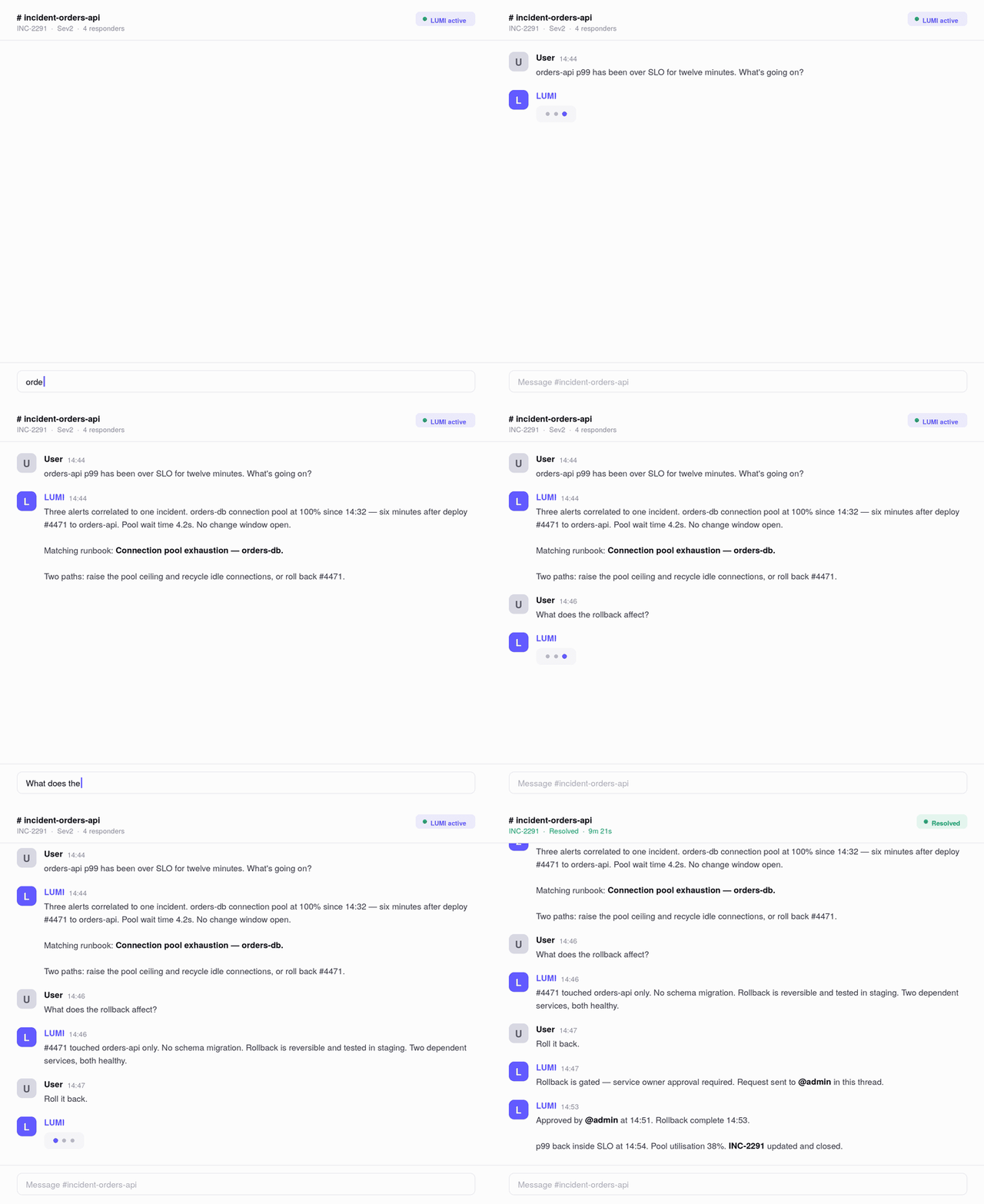
Incidents are worked in the channel. LUMI works there too: investigating, showing its
evidence, answering the follow-up question and executing once approved. One thread,
start to finish.
slack · #incident-orders-api
Investigate · approve · execute
14:44 first question to 14:54 verified recovery · a single thread and a single record
What teams automate
Automation coverage across eight
operational domains
Start with the highest-frequency procedure you run by hand today, then widen scope on
the execution record.
What teams automate
Automation coverage across eight
operational domains
Start with the highest-frequency procedure you run by hand today, then widen scope on
the execution record.
Runs inside your boundary
A private model deployed in your environment. Telemetry, configuration, topology and incident history do not leave it, and no execution path depends on a vendor-hosted endpoint.
One model of the estate
LUMI acts on the same model it observes across DCIM, AIOps, HCMP, FinOps and GreenOps. Dependency, owner and last change are known rather than inferred from an alert payload.
Governed autonomy, set per action
Oversight is assigned by reversibility and blast radius. Scope widens on the execution record and narrows when success rates drop.
Conversation and execution in one place
The investigation, the approval and the run happen in the same thread. There is no handoff to a separate automation console in the middle of an incident.
Writes back to the systems of record
The execution record lands in the ticket and the change record without manual copying, so the audit trail is a by-product of the work.
Additive to your stack
Logs, metrics, traces, topology and recent deploys are gathered and attached to the incident before an engineer opens it.
Hybrid and private cloud by design
Colocation, private cloud and public cloud, including the data centre layer, so power, cooling and capacity are part of the incident rather than a separate conversation.
Get started
Start with the procedure you run
most often
Bring a procedure your team currently executes manually. We
will configure it, apply the appropriate gate and walk through the
resulting execution record.
Autonomous ITOps platform powered by an AI Coworker, SRE Orchestrator, and Agent Builder
© 2026 – 2027 LumiOps.AI. All rights reserved.

© 2026 – 2027 LumiOps.AI. All rights reserved.